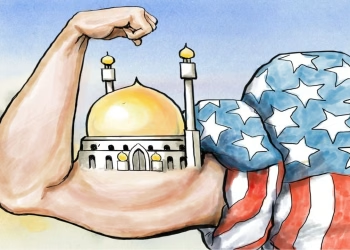
In sports, friendships and arguments, people have always picked a side. It’s natural to passionately believe in something and want to see it succeed against all odds. We need to take different sides and join different parties to diversify the conversation and challenge ourselves. The problem is politics is too complicated now for us to find common ground. Instead of listening, we fight with each other. How did we get here? When did the U.S. become so politically divided?
As a child, I remember listening to my family discussing current events such as political or significant developments, but didn’t understand what was really happening. It wasn’t until I entered grade school when the importance of political leadership was taught and I came to know then-President Barack Obama.
Lesson after lesson, I learned the aspects of Obama’s political campaign and the tasks he oversaw in the White House. It fascinated me to think someone could pass laws, appoint federal officials, and lead an entire nation. But what stood out to me the most about Obama was the fairness and integrity he carried with him.
I remember seeing this the most when I’d hear his speeches during my childhood. Not only did they involve eloquent storytelling and use of rhetorical devices, which easily grabbed the imagination of a child, but there was a focus on unity and hope. It was Obama’s ability to touch on the appeal of Americans’ shared values and common goals to form a connection. Even when Obama spoke on political or national conflicts, he remained level-headed and spoke truthfully to the nation. Obama reminded the country as long as we stayed united there was nothing to fear. I took his words seriously and for a time, as I grew up, it seemed any political issue could be successfully resolved as long as we worked together.
Now I ask myself every time I turn on the news, “what’s divided us?” It boils down to two factors: economics and social media. Research from University of Cambridge’s Political Psychology Lab confirms one of these factors through a study done on the 2008 U.S. financial crisis, which included massive bank failures and government bailouts. This triggered a global recession and a U.S. unemployment rate of 10% in 2009. The economic downturn marked a turning point where the division in politics and public life could first be felt. Many people were angry and blamed the federal government.
Social media also became a mainstream tool for public communication around this time, with 34% of online users discussing and reacting to the recession. People began to feel comfortable expressing their opinions online and found a sense of community through social media. However, this new form of communication also resulted in public-led narratives and the rapid spread of negative information.
Each of these factors effected how people perceived the country at-large. In middle school, I remember conversations with friends about how their parents would be working a lot. I’d see them spending time on their phone and scrolling through pictures of different people’s lives, comparing it to themselves. Is it envy or ambition that drives people? To this day, I don’t know.
In 2016, then-presidential candidate Donald Trump won the election over Hillary Clinton. The president’s instinct-driven attitude won him the popular vote. He wasn’t afraid to take care of business or call things as they were. It was the same attitude people who use social media have expressed and wanted for so long. People felt with him as president, he’d get the country back on track and narrow the political divide. However, throughout his tenure in the White House, the political division hasn’t narrowed.
As of late, our country has been experiencing a rise in political violence. First, there was the shocking assassination attempt on President Trump during a rally in Pennsylvania in 2024. That same year, there was the second assassination attempt on the president at his golf club in Florida. Then the gruesome assassination of Charlie Kirk, a right-wing political activist, at an outdoor campus debate at Utah Valley University occurred. As more news spread, people took notice of the lack of emotional distress my generation showed while this occurred.
I was home when I got the notification on my phone about the White House Correspondents’ Dinner shooting on the evening of April 25. This was the third act of political violence aimed at the Trump administration. But still, my generation was desensitized to it. Whether its acceptance of the inevitable or hatred toward the Republican Party, this knowledge is a wake-up call. Whether you’re conservative or liberal, this should scare you as much as it does me.
America’s 250th birthday is next month, a time celebration which should bring people together. But it’s still having the opposite effect. What’s divided us comes down to our choices. We choose to stay divided because we don’t want to talk face-to-face with others about our struggles. Instead, we let social media or another person’s actions speak for us. Now that I know the answers to these questions about how we got this point, I know how to break the cycle and bend this delicate bond.
I want to talk with others about national affairs regardless if they’re family or friends. I want to share my opinion honestly even if there’s a risk of disagreement. I’ll listen to what others have to say. And if it takes a turn for the worse, I’ll suggest we put the conversation to rest.
Will you join me in doing the same?
Featured image: Photo by Jon Tyson on Unsplash
Edited by James Sutton